
— Court record removal
Whether the case was dismissed, decided years ago, or is a civil matter that was nobody's business, a court record in your search results can cost you jobs, housing, and opportunities. We remove it from Google — discreetly, and for good.
We'll get back to you within 24 hours.
— The short answer
Yes — in most cases the court record can be removed from your Google search results. Sometimes we remove or de-index the specific search result that surfaces the record; sometimes we clear the underlying record itself through sealing or expungement, after which the copies online lose their footing. And when a record legally can't be removed, we suppress it so it no longer appears on the first page of Google. The right path depends on your case — and we'll tell you exactly which one fits during a free, confidential review.
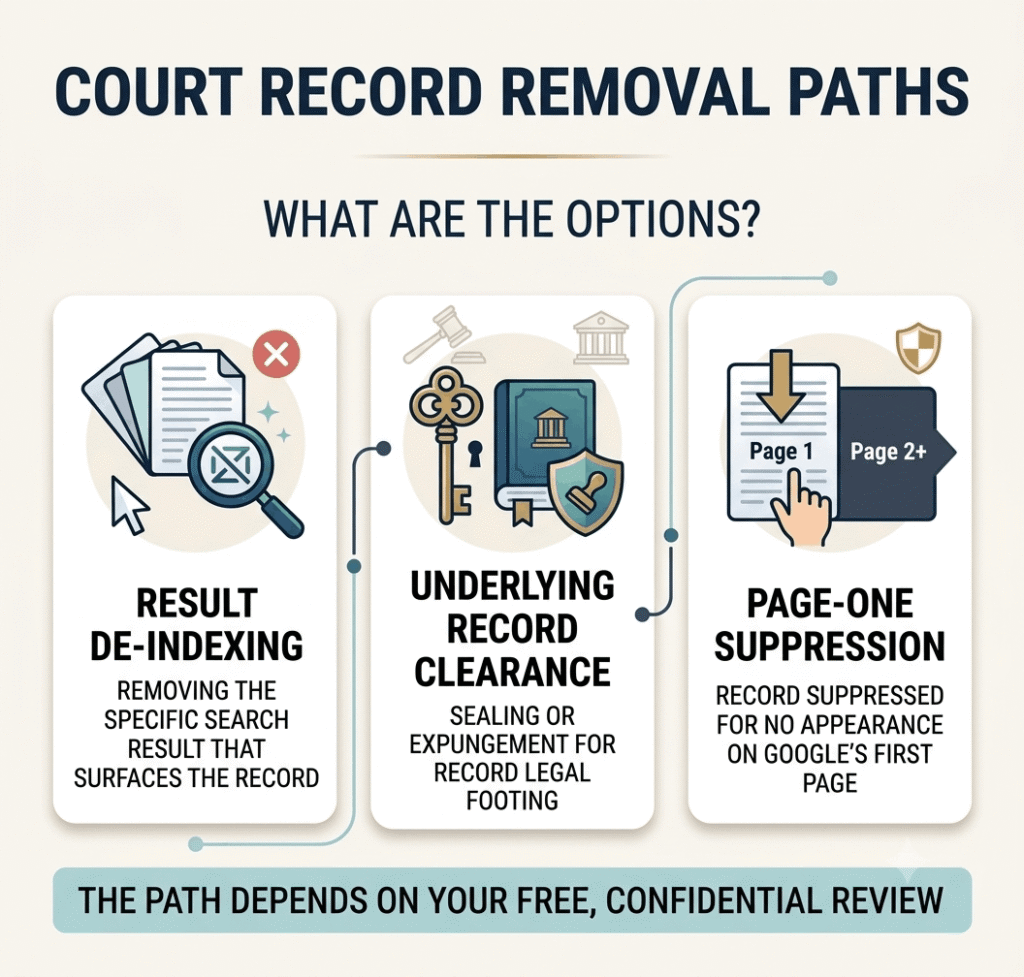
— THE ONE DISTINCTION THAT SAVES YOU MONTHS
This is the single most important thing to understand — and the thing most people get wrong. The court record itself (the document held by the court or a legal database) and the Google search result that points to it are two separate problems, with two different solutions.
Most court records are public, so they often can’t simply be deleted on request. But the Google result that surfaces the record can very often be removed or de-indexed — and that’s what actually affects how people see you. Alternatively, if you clear the underlying record through sealing or expungement, every site republishing it loses its legal basis to keep it up. Confusing these two paths is the number-one reason people waste months and money chasing the wrong fix. We don’t. We identify the right path for your specific case from day one.
— Court records we handle
Arrest records, charging documents, court dockets and filings, plea agreements, sentencing and probation records, and appeals including cases that were dismissed or where you were never convicted.
Lawsuits (as plaintiff or defendant), divorce proceedings, bankruptcy filings, small claims, restraining orders, custody cases, and foreclosures — matters that are often nobody’s business but yours.
— How we remove court records
The fastest win is usually getting the hosting site — a court portal, legal database, or aggregator — to de-index or redact the page. Once the source page is gone, Google drops the result within 24–72 hours.
The most durable fix is clearing the underlying record. Where your case qualifies, we help coordinate the documentation and then use that order to force removal from every site republishing it.
Google will remove results that expose sensitive personal information, or that point to legally expunged or sealed records. We file and manage these requests correctly.
Court records are copied across many legal-database and data-broker sites. We find every place your record appears and pursue removal at each one — not just the first result you noticed.
When a record legitimately can’t be removed, we suppress it — ranking positive content above it until it falls off page one.
— Removal vs. suppression
Dismissed, sealed, or expunged cases, records exposing private data, and cooperative host sites can often be removed or de-indexed outright — the cleanest outcome.
Public civil records and government-hosted records that can’t be sealed usually can’t be deleted. Suppression protects you here — we outrank the record until it drops off the first page, where fewer than 1% of people ever look.
— A simple, confidential process
Send us your name or the link. We find every site the record appears on and assess your best path — free and private.
Whether we remove, de-index, seal/expunge, or suppress — and a realistic timeline. No false promises.
We pursue removal at every source, coordinate any legal documentation, and manage the Google requests.
We monitor so the record doesn’t quietly resurface on another database, and protect your results going forward.
— An honest note
Be wary of anyone who promises to “delete your court record from the internet” for a flat fee. Public records often can't be erased outright, and confusing the record with the search result is exactly how people lose months and money. We'll tell you the truth about your case — what can be removed, what needs sealing or expungement, and what must be suppressed — before you spend anything. That honesty is why people trust us with something this personal.
— Case study
Client
What we did
Problem
Result
— Questions
Yes, in most cases. We remove or de-index the search result that surfaces the record, clear the underlying record through sealing or expungement where eligible, or suppress it when it can’t be removed. The right path depends on your case, which we assess in a free, confidential review.
The record is the document held by a court or database; the search result is the Google listing that points to it. Public records often can’t be deleted, but the Google result can frequently be removed or de-indexed — and that’s what changes what people actually see.
Yes — these are the strongest cases. If your case was dismissed, or you qualify for sealing or expungement, we use that to force removal from the sites hosting the record, then clear it from Google.
Often, yes — through de-indexing or source removal. Public civil records can be harder to delete outright, but they can reliably be suppressed off page one when removal isn’t possible.
We suppress it. By ranking positive, accurate content above it, we push the record off the first page of Google — where fewer than 1% of people ever look — so it effectively disappears from view.
Once a source page is cleared, Google typically de-indexes it within 24–72 hours. Full removal or suppression across multiple sites usually takes 30–90 days. We give you a realistic timeline during your free review.
Completely. Everything is handled with total discretion. We never share client identities, and your situation stays private from start to finish.
FINAL CALL TO ACTION
A free, confidential review — we’ll find every site it’s on and tell you exactly how we’ll take it down.